
Clear influenza vaccination recommendations do not consistently translate into protection in Germany
Germany has clear national influenza vaccination recommendations for adults aged 60+, yet vaccination coverage has fallen while severe influenza burden remains concentrated in older adults. With most unvaccinated high-risk adults already interacting with healthcare services during the vaccination period, the central challenge is translating existing recommendations and healthcare touchpoints into more consistent protection.
Influenza vaccination coverage among adults aged 60+ continues to decline
Influenza vaccination coverage among adults aged 60+ fell to 34.5% in 2024/25, almost 13 percentage points below the level recorded in 2020/21 and less than half of the WHO target of 75%.3,11
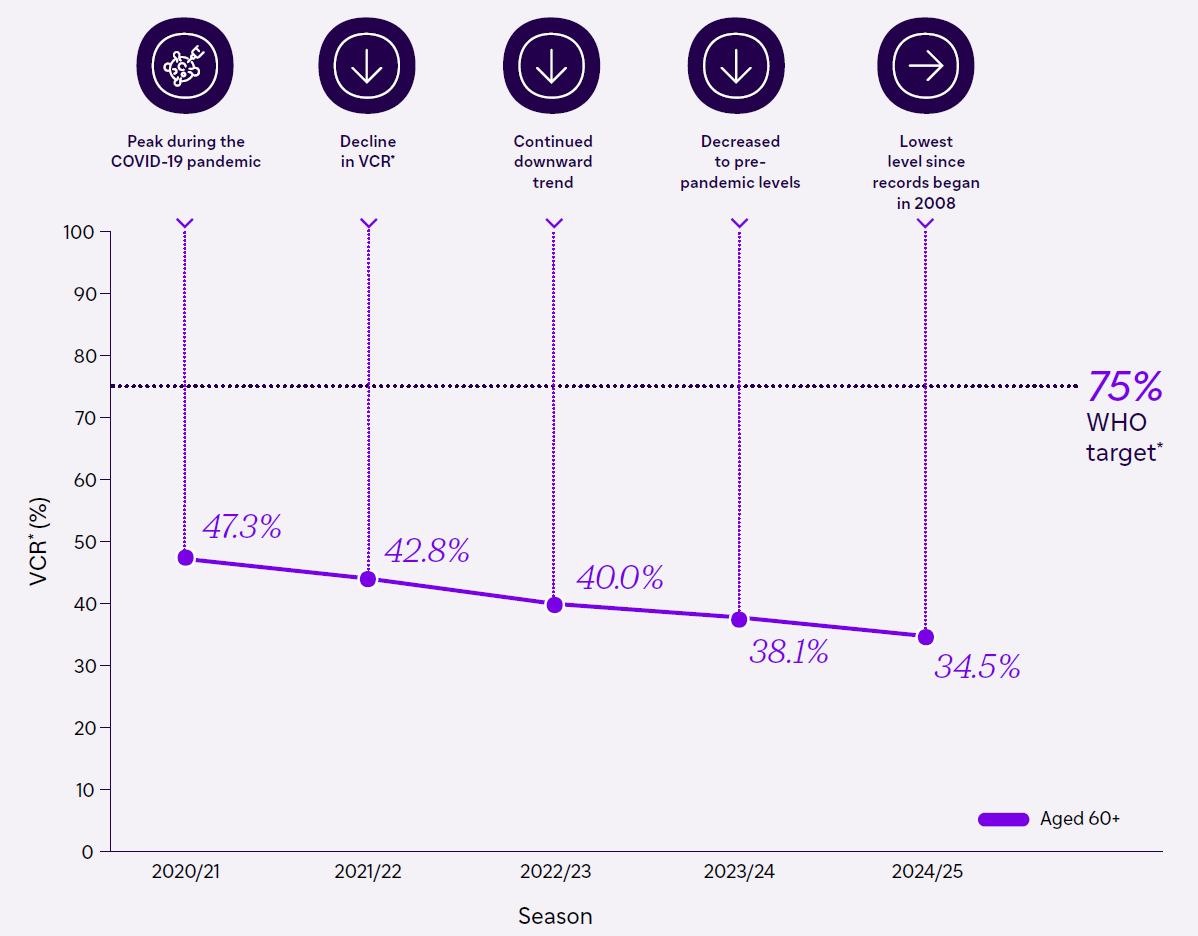
As comprehensive data for the 2025/26 influenza season were not available at the time of analysis, this report draws on data from the 2024/25 season alongside historical trends.
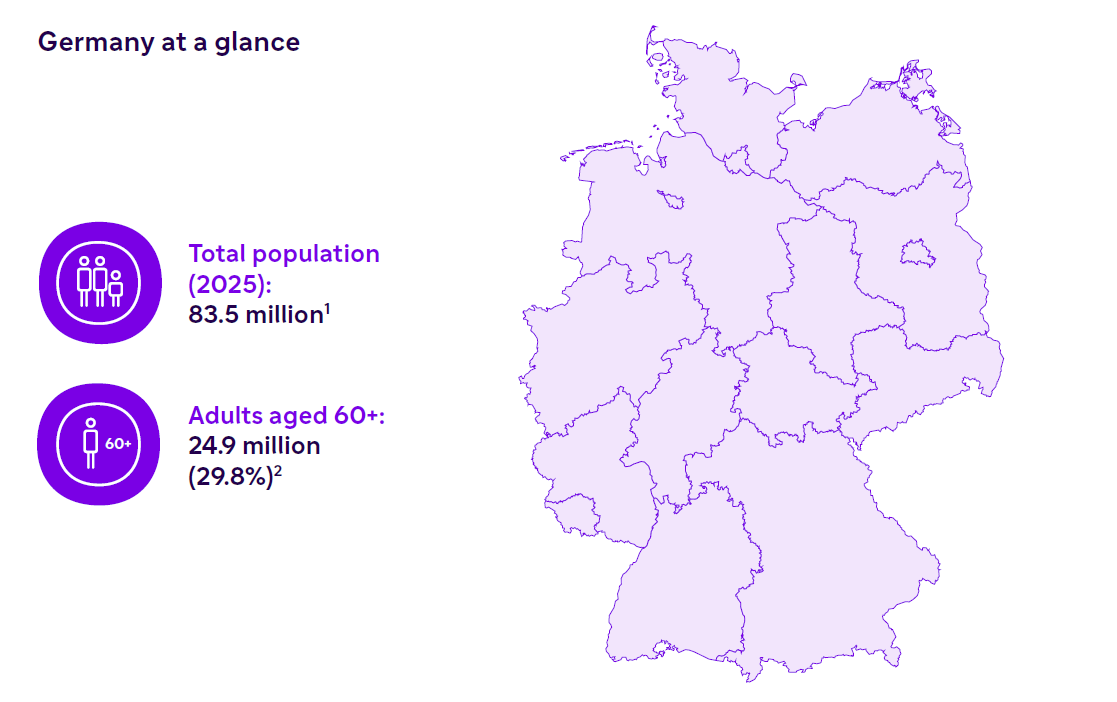
24.9 million
Adults aged 60+
29.8% of Germany's population.2
12.8 percentage points
Decline since 2020/21
From 47.3% to 34.5% in 2024/25.3
40.5 percentage points
Below the WHO target
34.5% vaccination coverage versus a 75% target.3,11
Severe influenza/influenza-like illness burden is concentrated among adults aged 60+
Influenza/influenza-like illness (ILI)-related hospitalizations increased by around 50% between 2023/24 and 2024/25, reaching 87,745 - the highest level since 2019. Adults aged 60+ accounted for 53.2% of these hospitalizations.5
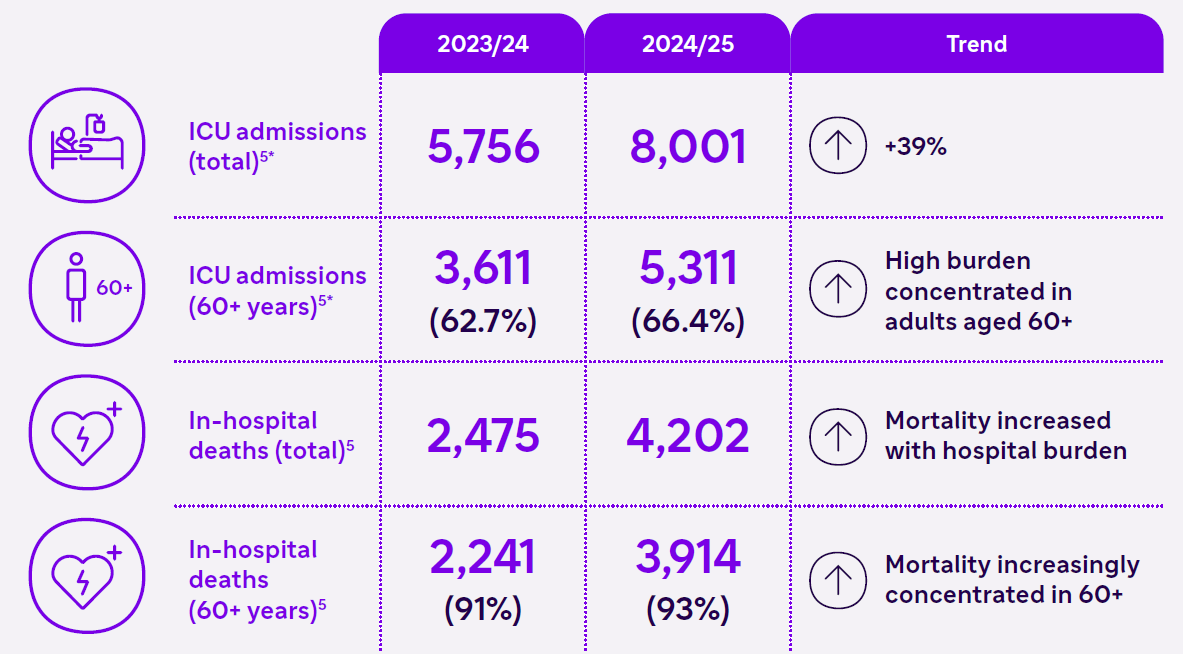
Among adults aged 60+ hospitalized with influenza/ILI in 2024/25, 11.4% required intensive care and 8.4% died in hospital.5
German cardiologists identify respiratory and cardiovascular complications in influenza-related hospitalizations
Surveyed cardiologists identified both respiratory and cardiovascular complications among the main causes of influenza-related hospitalization in older adults.
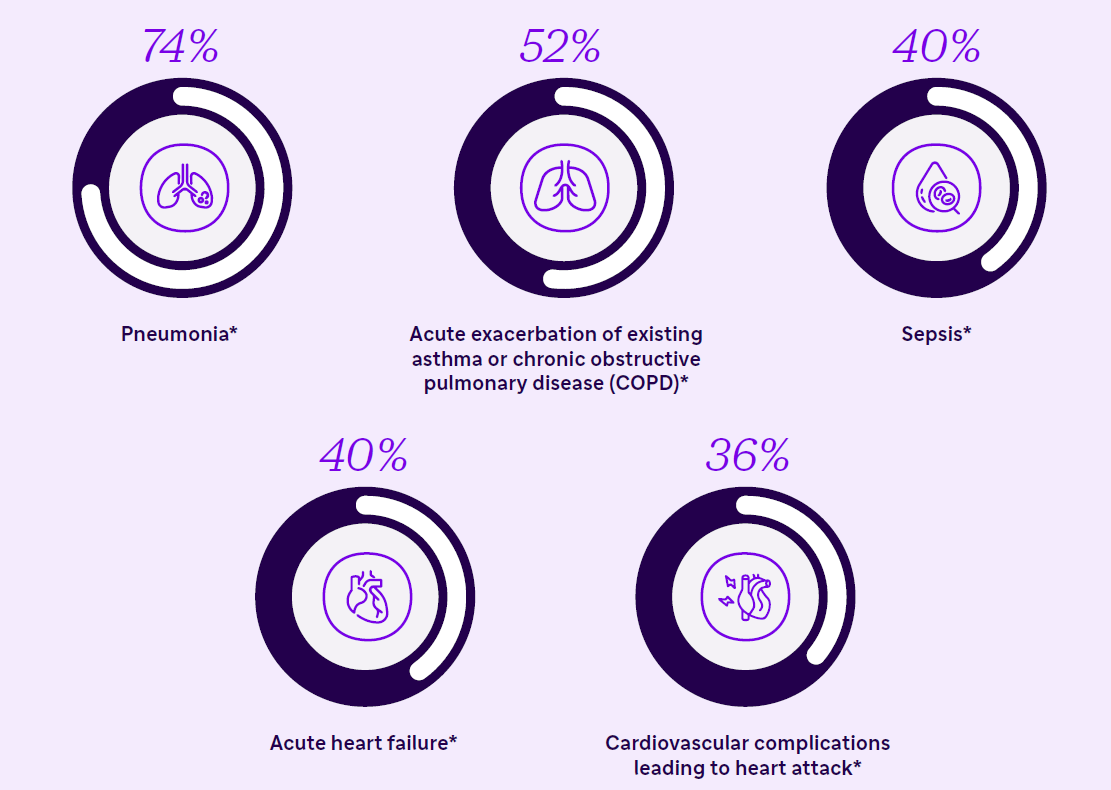
What HCPs said
Some cardiologists also identified comorbidities, heart failure or cardiac decompensation, respiratory failure and advanced age among the factors contributing to hospitalization among patients with influenza.
Influenza/ILI hospital costs in Germany are driven by case volumes
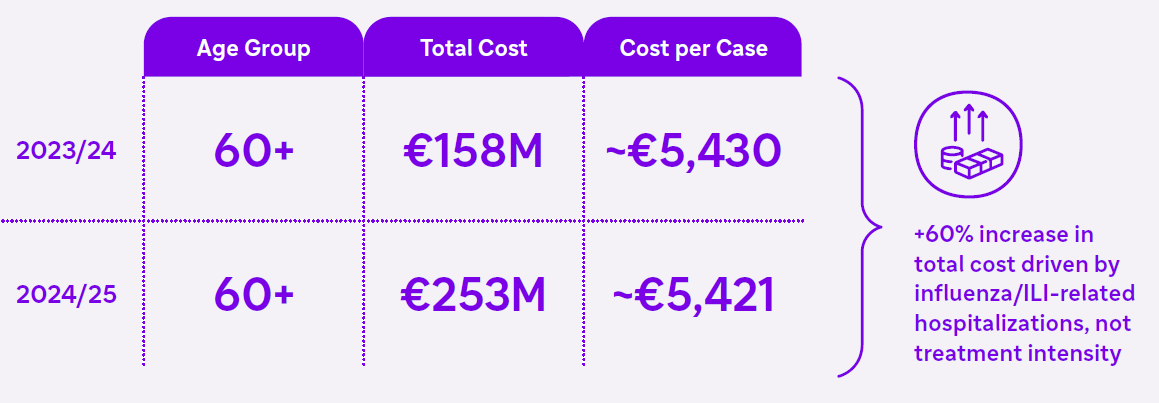
Among adults aged 60+, hospital costs increased from €158 million in 2023/24 to €253 million in 2024/25. Costs per case remained broadly stable at approximately €5,430 and €5,421 respectively.5
The increase was driven by a higher volume of influenza/ILI-related hospitalizations rather than higher costs per case.5
Clear national influenza vaccination recommendations are not consistently translating into uptake
STIKO recommends annual influenza vaccination for all adults aged 60+ and other eligible risk groups. Nevertheless, vaccination coverage was just 34.5% in 2024/25, well below the WHO target of 75%.3,10,11
Approximately 95% of unvaccinated adults aged 60+ with chronic conditions had at least one general practitioner (GP) contact during the recommended vaccination period, and half had at least five visits.15
Make better use of routine healthcare touchpoints
Systematically use routine healthcare encounters to assess vaccination status, recommend influenza vaccination and offer vaccination.15
Vaccination coverage does not show which vaccine was administered
Information on the proportion of adults aged 60+ receiving age-specific vaccines is not available for this analysis. It is therefore not possible to assess how consistently STIKO recommendations are reflected in vaccination practice.10
Surveyed primary care HCPs in Germany identify patient-related and practical barriers to influenza vaccination
Surveyed primary care HCPs reported that low perceived need and risk, vaccine fatigue and tolerability concerns were barriers to influenza vaccination among adults aged 60+.
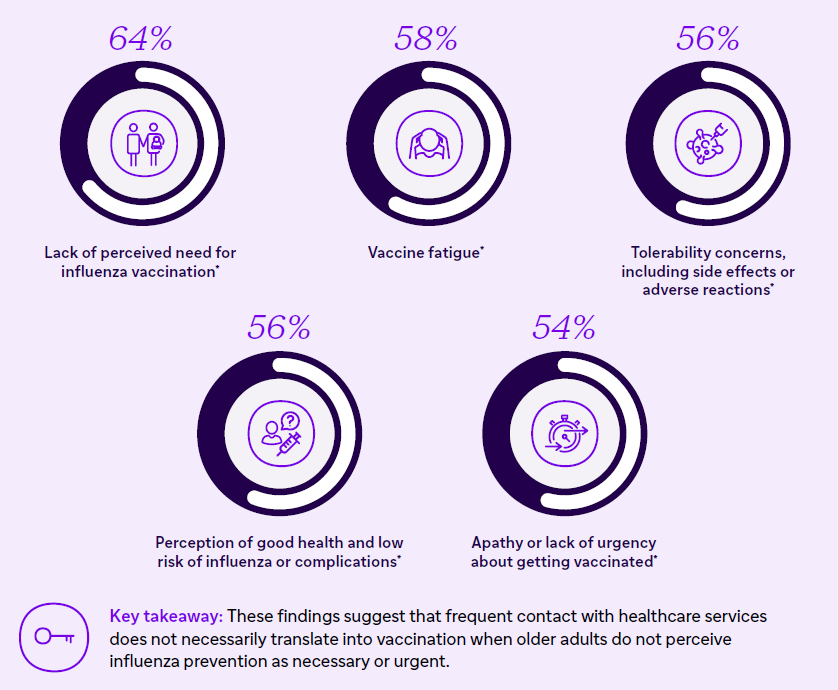
Practical barriers can also affect influenza vaccination delivery and access
Practical constraints identified by surveyed HCPs included accessibility for homebound or immobile patients (21%), staffing levels and availability (21%), appointment availability (18%), vaccine supply and availability (17%), and clinic hours (12%).
What HCPs said
Surveyed cardiologists suggested that responsibility for influenza vaccination can become unclear across the care pathway, even when older adults recognize their risk and actively seek vaccination.
More patients are aware that they belong to a high-risk group and are actively asking for a vaccination; however, as vaccination is usually the responsibility of the GP, it is sometimes unclear who is responsible.
Three priorities to strengthen influenza protection among adults aged 60+ in Germany
Germany has clear national influenza vaccination recommendations for adults aged 60+ and other eligible groups, but gaps remain in how consistently these translate into vaccination in practice. Strengthening protection requires action across three areas: making better use of routine healthcare touchpoints, increasing vaccination uptake while ensuring protection reflects age and risk, and integrating influenza prevention more consistently across the care pathway.
1
Make better use of routine healthcare touchpoints
Make vaccination assessment and recommendation a central part of routine healthcare interactions for adults aged 60+.
2
Increase vaccination coverage with age-specific protection
Increase uptake among adults aged 60+ while ensuring protection reflects their age and risk through consistent use of age-specific vaccines in line with national recommendations.
3
Integrate influenza prevention across the care pathway
Integrate influenza prevention more consistently across the care pathway, creating additional opportunities to identify, recommend and offer vaccination to adults aged 60+.
Explore Flunomics
Download the Germany report to read the full country analysis, including vaccination coverage, severe influenza/ILI burden, economic impact, HCP perspectives, implementation barriers and opportunities for Germany.
Visit the global Flunomics homepage to explore evidence from other countries, global findings, methodology and comparisons of vaccination coverage.
HCP survey sources and footnotes
SA3 - Main causes of influenza-related hospitalization (report p. 6)
Source: Ipsos online survey conducted on behalf of Sanofi among healthcare professionals (HCPs) in Germany; fieldwork conducted 10 June-7 July 2026. Results reflect the views and practices of the surveyed sample.
Base: Cardiologists (n=50).
* Question SA3: Cardiologists were asked which complications of influenza were the main causes of hospitalization; respondents could select multiple complications. The figures shown were not necessarily the most frequently selected answer options by surveyed HCPs.
SA2b - Qualitative response on factors contributing to hospitalization (report p. 7)
Source: Ipsos online survey conducted on behalf of Sanofi among HCPs in Germany; fieldwork conducted 10 June-7 July 2026. Results reflect the views and practices of the surveyed sample.
Base: Cardiologists (n=50).
* Question SA2b: Cardiologists were asked, in their own words and based on their clinical experience, what key factors lead to hospitalization for patients with influenza. Unprompted open-ended responses were analyzed using generative AI (GenAI)-assisted thematic analysis of verbatim free-text responses to identify key themes. Themes shown represent mentions from open-ended responses and should not be interpreted as majority consensus. The quote is reproduced from an individual cardiologist response.
PC4 - Patient-related vaccination barriers (report p. 10)
Source: Ipsos online survey conducted on behalf of Sanofi among HCPs in Germany; fieldwork conducted 10 June-7 July 2026. Results reflect the views and practices of the surveyed sample.
Base: Primary care HCPs (n=151: 100 GPs/family physicians (FPs) and 51 pharmacists).
* Question PC4: Primary care HCPs were asked to consider patient-driven barriers to influenza vaccination among their older adults (aged 60+) and select all the barriers they encounter in practice. Respondents could select multiple responses from a list of potential options. The figures shown were not necessarily the most frequently selected answer options by surveyed HCPs.
PB4 - Practical implementation and access barriers (report p. 11)
Source: Ipsos online survey conducted on behalf of Sanofi among HCPs in Germany; fieldwork conducted 10 June-7 July 2026. Results reflect the views and practices of the surveyed sample.
Base: Primary care HCPs (n=151: 100 GPs/FPs and 51 pharmacists).
* Question PB4: Primary care HCPs were asked to consider local influenza prevention policy and identify its main weaknesses hindering protection of older adults aged 60+. Respondents could select up to three responses from a list of potential options. The figures shown were not necessarily the most frequently selected answer options by surveyed HCPs.
SC3 - Qualitative response on vaccination responsibility (report p. 11)
Source: Ipsos online survey conducted on behalf of Sanofi among HCPs in Germany; fieldwork conducted 10 June-7 July 2026. Results reflect the views and practices of the surveyed sample.
Base: Primary care HCPs (n=151: 100 GPs/FPs and 51 pharmacists).
† Question SC3: Cardiologists were asked about the practical implementation of influenza prevention guidelines for older adults, whether national, regional or local, including what works well in practice and what does not. Unprompted open-ended responses were analyzed using GenAI-assisted thematic analysis of verbatim free-text responses to identify key themes. Themes shown represent mentions from open-ended responses and should not be interpreted as majority consensus. The quote is reproduced from an individual cardiologist response.
References
- Destatis. Population by nationality and sex. Available at: https://www.destatis.de/EN/Themes/Society-Environment/Population/Current-Population/Tables/census-sex-and-citizenship-2025.html [Last accessed: October 2026].
- Destatis. Population by age groups 2011 to 2024 in percent. Available at: https://www.destatis.de/EN/Themes/Society-Environment/Population/Current-Population/Tables/lrbev01ga.html [Last accessed: October 2026].
- Robert Koch Institut. Influenza: Impfquote (ab 60 Jahre). Available at: https://www.gbe.rki.de/EN/Topics/HealthPromotionPreventionAndCare/HealthPromotionAndPrevention/DiseasePrevention/InfluenzaVaccination/InfluenzaVaccination_node.html?kennzahl=1&darstellung=1&zeit=2024&geschlecht=0&standardisierung=0 [Last accessed: October 2026].
- European Health Observatory. Germany country health profile 2025. Available at: https://eurohealthobservatory.who.int/publications/m/germany-country-health-profile-2025 [Last accessed: October 2026].
- Meyer AC, et al. Clinical and economic inpatient burden of influenza and influenza-like illness in Germany 2019-2025: Analysis of nationwide hospital data. Infect Dis Ther. 2026;15:2335–2348.
- Destatis. By 2035, one quarter of Germany’s population will be aged 67 or over. Available at: https://www.destatis.de/EN/Press/2025/12/PE25_446_12.html [Last accessed: October 2026].
- Federal Republic of Germany. Sozialgesetzbuch (SGB) Funftes Buch (V) – Gesetzliche Krankenversicherung, § 20i Leistungen zur Verhütung übertragbarer Krankheiten, Verordnungsermächtigung. Available at: https://www.gesetze-im-internet.de/sgb_5/__20i.html [Last accessed: October 2026].
- Federal Republic of Germany. Gesetz zur Verhütung und Bekämpfung von Infektionskrankheiten beim Menschen (Infektionsschutzgesetz – IfSG), § 20 Schutzimpfungen und andere Maßnahmen der spezifischen Prophylaxe. Available at: https://www.bmas.de/SharedDocs/Downloads/DE/Gesetze/infektionsschutzgesetz-ifsg.html [Last accessed: October 2026].
- Federal Republic of Germany. Gesetz zur Stärkung der Gesundheitsförderung und der Prävention (Präventionsgesetz – PrävG) vom 17. Juli 2015. Bundesgesetzblatt Teil I. 2015;(31):1368. Available at: https://www.bgbl.de/xaver/bgbl/start.xav?jumpTo=bgbl115s1368.pdf [Last accessed: October 2026].
- STIKO recommendations 2026. Available at: https://www.rki.de/EN/Topics/Infectious-diseases/Immunisation/STIKO/STIKO-recommendations/Downloads/04_26_english.pdf?__blob=publicationFile&v=4 [Last accessed: October 2026].
- World Health Organization. Understanding drivers of influenza vaccine uptake. Available at: https://www.who.int/news-room/feature-stories/detail/understanding-drivers-of-influenza-vaccine-uptake [Last accessed: October 2026].
- Meyer AC, et al. Epidemiology and economic burden of medically attended influenza and influenza-like illness in Germany, 2016–2019. J Med Econ. 2026;29:972–985.
- Damm O, et al. Prevalence of chronic conditions and influenza vaccination coverage rates in Germany: Results of a health insurance claims data analysis. Influenza Other Respi Viruses. 2023;17:e13054.
- ABDA – Federal Union of German Associations of Pharmacists. Grippeschutzimpfungen. Available at: https://www.abda.de/themen/grippeschutzimpfungen/ [Last accessed: October 2026].
- Gensorowsky D, et al. Outpatient care intensity and influenza vaccination: evidence from Germany. Vaccine. 2026;70:128038.
- Robert Koch Institut. IMPRESS: Ergebnisse zur Grippeimpfung. Slide 29. Available at: https://www.rki.de/DE/Themen/Infektionskrankheiten/Impfen/Forschungsprojekte/IMPRESS/Folien-Ergebnisse-Grippeimpfung.pdf?__blob=publicationFile&v=5 [Last accessed: October 2026].

MAT-GLB-2604353-v1.0-11/2026.