
A first-of-its-kind view of influenza’s impact and critical gaps of preparedness
Flunomics brings together epidemiological, vaccination, economic, and policy evidence from across nine countries, complemented by healthcare professional perspectives, to build a more complete picture of the impact of influenza and identify where protection gaps remain – particularly for older adults.

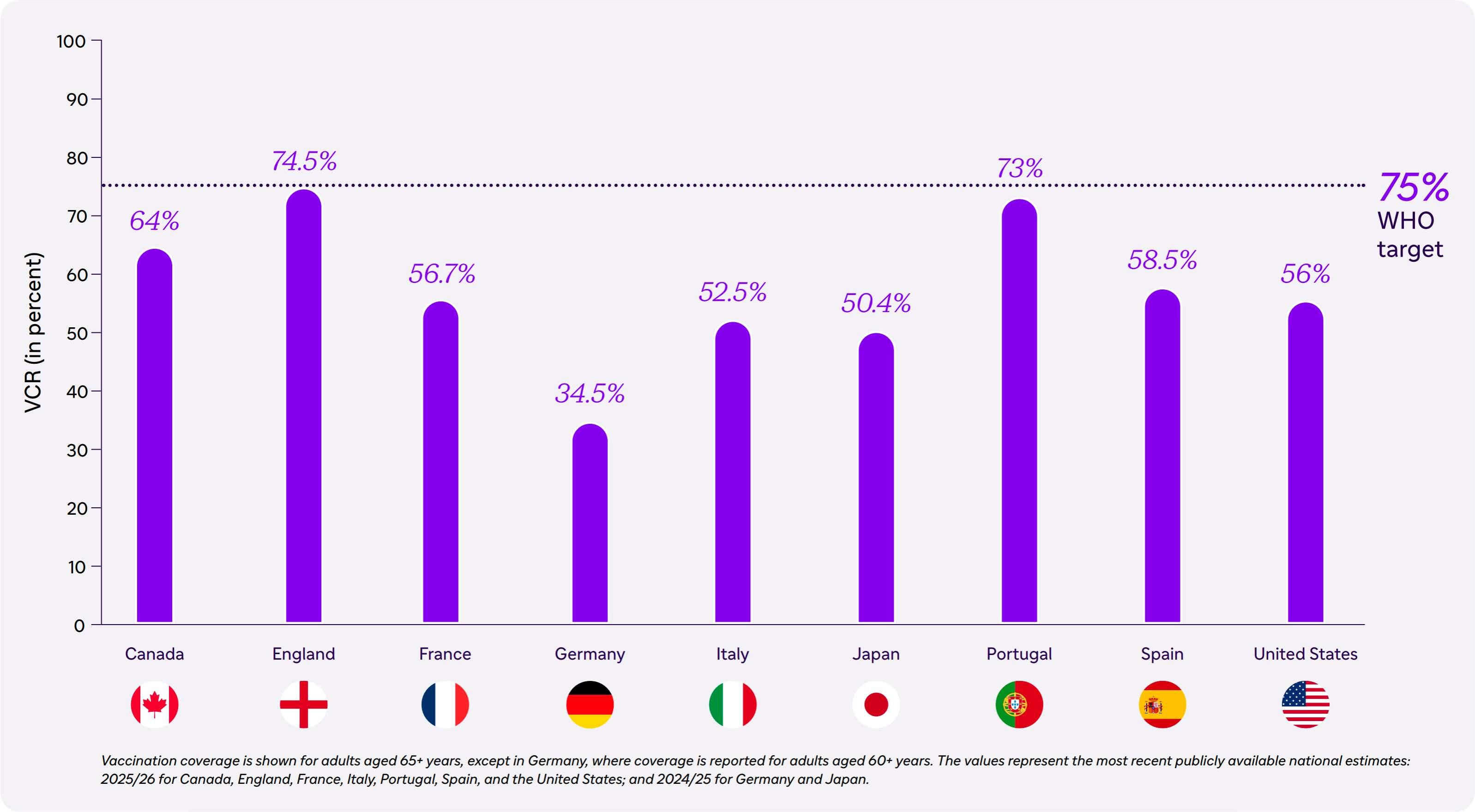
Influenza vaccination rates remain below target across countries
Vaccination remains the primary population-level strategy for preventing severe influenza, yet the latest available national estimates show coverage among older adults remains below the WHO target of 75% across all nine Flunomics-assessed countries. In some countries, coverage has also stagnated or declined in recent years.
We asked PCPs in Spain about the practical implementation of influenza prevention guidelines for older adults, and one shared the following perspective:

Looking beyond vaccination coverage to better understand protection
Vaccination coverage tells us how many older adults are vaccinated, but it does not tell us whether they are receiving age-specific vaccines which can provide them with the appropriate protection appropriate their age and risk. Understanding protection requires looking at influenza burden alongside how vaccination policy and recommendations are implemented.

What burden remains despite vaccination programmes?
Older adults continue to experience a disproportionate share of severe influenza outcomes, including complications, hospitalization, loss of independence and death. Influenza is also associated with an increased short-term risk of acute cardiovascular events.
What are the wider consequences of influenza?
Influenza contributes to healthcare demand and pressure on health systems, while Flunomics also examines its wider economic impact on individuals, health systems and society.
How do vaccination policy recommendations translate into protection?
Protection depends on whether policy is implemented effectively, vaccination reaches those at greatest risk, and vaccination strategies reflect age-related risk, including the use of age-specific vaccines where recommended.
We asked pharmacists in the US about the main challenges to optimizing influenza protection among older adults, and one shared the following perspective:

Explore the evidence and what needs to change by country
Declining vaccination coverage rates and provincial variation shape influenza protection across Canada
Coverage among adults aged 65+ has fallen, while access to age-specific influenza vaccines varies across provinces and territories.
Declining vaccination coverage and age-related risk shape influenza protection in England
Coverage has fallen from previous highs, particularly among adults aged 65–74, while severe influenza outcomes remain concentrated in older adults.
France has strong influenza vaccination foundations, but protection gaps remain for adults aged 65+
Coverage remains below the WHO target, while severe influenza outcomes remain concentrated in adults aged 65+ despite established delivery pathways.
Clear influenza vaccination recommendations are not consistently translating into protection in Germany
Coverage among adults aged 60+ has fallen, while severe influenza/ILI burden remains concentrated in this population despite frequent healthcare contact.

Declining vaccination coverage and regional implementation shape influenza protection in Italy
Free vaccination begins at age 60, but coverage among adults aged 65+ has declined for four consecutive seasons and implementation varies across regions.
Declining vaccination coverage and evolving age-specific policy shape influenza protection in Japan
Coverage has declined overall, while age-specific influenza vaccination policy and timely national coverage data continue to evolve.
Historically high influenza vaccination coverage is beginning to weaken in Portugal
Free vaccination, broad access and regular monitoring have supported high uptake, but coverage among adults aged 65+ has declined in recent seasons.
Spain's decentralized healthcare system creates regional variation in influenza vaccination implementation
Annual vaccination is recommended nationally from age 60, but age-specific eligibility and implementation vary across autonomous communities.
Influenza risk begins before age 65 in the United States
Coverage is declining among adults aged 50–64 and 65+, while chronic disease and healthcare use show that influenza risk is already present before age 65.

Explore the full Flunomics report
Download the global report for the complete evidence base, country analyses, healthcare professional perspectives, methodology and country-specific recommendations.
About Flunomics
Flunomics is an evidence-led initiative examining how influenza affects older adults, health systems, and society. It brings together epidemiological, vaccination, economic, and policy evidence to understand the burden of influenza, identify gaps in protection, and highlight what needs to change to strengthen prevention and preparedness.
Each edition reflects the most recent evidence available at the time of analysis, while recognizing that surveillance systems, reporting practices, and data availability differ between countries. Findings should therefore be interpreted within their national context.
References
View sources and citations for the data presented in this report.
1. World Health Organization. Seasonal influenza vaccination: developing and strengthening national programmes. Geneva: WHO; 2024.
2. World Health Organization Regional Office for Europe. A global influenza vaccination target has existed for 2 decades – yet only 4 countries in the European Region are hitting it. 2026.
3. Health Infobase. Seasonal Respiratory Vaccination Coverage Survey (SRVCS): Vaccination coverage report. — Canada.
4. UK Health Security Agency. Influenza in the UK, annual epidemiological report: winter 2025 to 2026. — England.
5. Santé publique France. Flu vaccination coverage data by age group.
6. Santé Publique France. Bulletin infections respiratoires aiguës. Édition nationale. Semaine 15 (6 au 12 avril 2026). — supports the 2025/26 France data.
7. Robert Koch Institut. Influenza: Impfquote (ab 60 Jahre). — Germany.
8. Ministero della Salute. Vaccination coverage data. — Italy.
9. Ministry of Health, Labour and Welfare, Japan. Number of people receiving routine vaccinations.
10. Sociedade Portuguesa de Pneumologia. 87% dos portugueses com 85 ou mais anos já estão vacinados contra a gripe. — the Vacinómetro source used for the 2025/26 Portugal estimate.
11. Direção-Geral da Saúde. Relatório n.º 28 / Relatório da Vacinação Sazonal. — Portugal.
12. Ministerio de Sanidad. Sistema de Información de Vacunaciones (SIVAMIN). — Spain.
13. Data on file. Three-year influenza vaccination coverage rate (VCR). REF-344034. — United States.
14. World Health Organization. Vaccines against influenza: WHO position paper – May 2022. Weekly Epidemiological Record. 2022;97:185–208.
15. Veronese N, Dominguez LJ, Ganci A, et al. Influenza vaccination in older people: a geriatrician’s perspective. Aging Clin Exp Res. 2025;37(6):202.
16. World Health Organization. Influenza (seasonal).
17. Langer J, et al. High Clinical Burden of Influenza Disease in Adults Aged ≥65 Years: Can We Do Better? A Systematic Literature Review. Adv Ther. 2023;40:1601–1627.
18. Macias AE, et al. The disease burden of influenza beyond respiratory illness. Vaccine. 2021;39 Suppl 1:A6–A14.
19. Kwong JC, et al. Acute Myocardial Infarction after Laboratory-Confirmed Influenza Infection. N Engl J Med. 2018;378:345–353.